LC 102 - Binary Tree Level Order Traversal
LC 102 - Binary Tree Level Order Traversal
Question
Given the root of a binary tree, return the level order traversal of its nodes’ values. (i.e., from left to right, level by level).
Example 1:
1
2
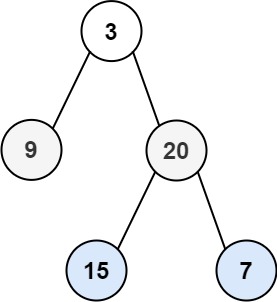
Input: root = [3,9,20,null,null,15,7]
Output: [[3],[9,20],[15,7]]
Example 2:
1
2
Input: root = [1]
Output: [[1]]
Example 3:
1
2
Input: root = []
Output: []
Constraints:
- The number of nodes in the tree is in the range
[0, 2000]. -1000 <= Node.val <= 1000
Links
Question here and solution here
Solution
concept
This is just a standard BFS.
code
1
2
3
4
5
6
7
8
9
10
11
12
13
14
15
16
17
18
19
20
21
22
23
24
25
26
27
28
29
30
31
32
33
34
35
36
37
38
39
40
41
42
43
44
45
46
47
48
49
50
51
52
# Definition for a binary tree node.
# class TreeNode:
#     def __init__(self, val=0, left=None, right=None):
#         self.val = val
#         self.left = left
#         self.right = right
class Solution:
    def levelOrder(self, root: Optional[TreeNode]) -> List[List[int]]:
        if not root:
            return []

        q = deque([root])
        ans = []
        while q:
            lvl = []
            for _ in range(len(q)):
                node = q.popleft()
                if node:
                    lvl.append(node.val)
                    if node.left:
                        q.append(node.left)
                    if node.right:
                        q.append(node.right)
            ans.append(lvl)
        return ans

class NeetSolution:
    """
    Very similar to the above solution
    """
    def levelOrder(self, root: Optional[TreeNode]) -> List[List[int]]:
        res = []
        q = deque()
        if root:
            q.append(root)

        while q:
            val = []

            for i in range(len(q)):
                node = q.popleft()
                # note the difference here
                # we first add node.val then check if node.left and node.right exist
                # hence there is no need to check if val is empty.
                # we are adding the node.val to the val list first
                val.append(node.val)
                if node.left:
                    q.append(node.left)
                if node.right:
                    q.append(node.right)
            res.append(val)
        return res
Complexity
time: $O(n)$
space: $O(n)$
This post is licensed under CC BY 4.0 by the author.