LC 2 - Add Two Numbers
LC 2 - Add Two Numbers
Question
You are given two non-empty linked lists representing two non-negative integers. The digits are stored in reverse order, and each of their nodes contains a single digit. Add the two numbers and return the sum as a linked list.
You may assume the two numbers do not contain any leading zero, except the number 0 itself.
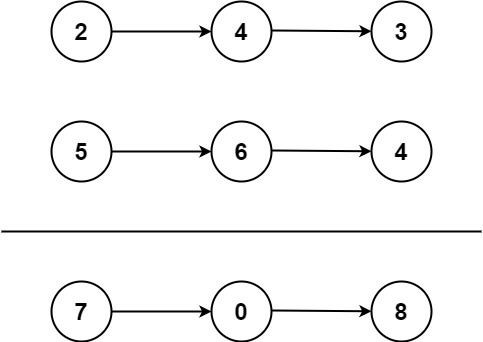
Example 1:
1
2
Input: l1 = [2,4,3], l2 = [5,6,4]
Output: [7,0,8]
Explanation: 342 + 465 = 807.
Example 2:
1
2
Input: l1 = [0], l2 = [0]
Output: [0]
Example 3:
1
2
Input: l1 = [9,9,9,9,9,9,9], l2 = [9,9,9,9]
Output: [8,9,9,9,0,0,0,1]
Constraints:
- The number of nodes in each linked list is in the range
[1, 100]. 0 <= Node.val <= 9- It is guaranteed that the list represents a number that does not have leading zeros.
Links
Question here and solution here
Solution
concept
We basically iterate through both list and add them up
- need to take care of carry in each addition
- if one of the list run out, we need to handle it by adding the other list to 0 (see NeetCode’s solution)
- there is an edge case like 8 + 7 = 15 where we need to convert the carry to an extra digit, this is handled by the
whilecondition in NeetCode’s solution.
code
1
2
3
4
5
6
7
8
9
10
11
12
13
14
15
16
17
18
19
20
21
22
23
24
25
26
27
28
29
30
31
32
33
34
35
36
37
38
39
40
41
42
43
44
45
46
47
48
49
50
51
52
53
54
55
56
57
58
59
60
61
62
63
64
65
66
67
68
69
70
71
72
73
74
75
76
77
78
79
80
81
82
83
84
85
86
87
88
89
90
91
92
93
94
95
96
97
# Definition for singly-linked list.
# class ListNode:
#     def __init__(self, val=0, next=None):
#         self.val = val
#         self.next = next
class Solution:
	"""
	own implementation, very crude
	"""
    def addTwoNumbers(self, l1: Optional[ListNode], l2: Optional[ListNode]) -> Optional[ListNode]:
        cur_1 = l1
        cur_2 = l2
        dummy = ListNode(0)
        carry = False
        prev = dummy
		# add two list first
        while cur_1 and cur_2:
            _sum = cur_1.val + cur_2.val
            if carry:
                _sum += 1
            if _sum >= 10:
                val = _sum % 10
                carry = True
            else:
                val = _sum
                carry = False
            cur = ListNode(val)
            prev.next = cur
            prev = cur
            cur_1 = cur_1.next
            cur_2 = cur_2.next
		# handle the leftover of either one list
        if cur_1:
            while cur_1:
                _sum = cur_1.val
                if carry:
                    _sum += 1

                if _sum >= 10:
                    val = _sum%10
                    carry = True
                else:
                    val = _sum
                    carry = False
                cur = ListNode(val)
                prev.next = cur
                prev = cur
                cur_1 = cur_1.next
        elif cur_2:
            while cur_2:
                _sum = cur_2.val
                if carry:
                    _sum += 1

                if _sum >= 10:
                    val = _sum%10
                    carry = True
                else:
                    val = _sum
                    carry = False
                cur = ListNode(val)
                prev.next = cur
                prev = cur
                cur_2 = cur_2.next
		# handle edge cases where there is a final carry we need one more digit 1 infront.
        if carry:
            cur = ListNode(1)
            prev.next = cur
            cur.next = None

        return dummy.next

# Definition for singly-linked list.
# class ListNode:
#     def __init__(self, val=0, next=None):
#         self.val = val
#         self.next = next
class Solution:
    def addTwoNumbers(self, l1: Optional[ListNode], l2: Optional[ListNode]) -> Optional[ListNode]:
        dummy = ListNode()
        cur = dummy
        carry = 0

        while l1 or l2 or carry: # if both l1 and l2 are None, only carry is not None, it means the 8 + 7 = 15 case whre we need the extra digit for the carry.
            v1 = l1.val if l1 else 0
            v2 = l2.val if l2 else 0
            # new digit
            val = v1 + v2 + carry
            carry = val // 10
            val = val % 10
            cur.next = ListNode(val)
            # update pointers
            cur = cur.next
            l1 = l1.next if l1 else None
            l2 = l2.next if l2 else None

        return dummy.next
Complexity
time: $O(m+n)$
space: $O(1)$
This post is licensed under CC BY 4.0 by the author.