LC 212 - Word Search II
LC 212 - Word Search II
Question
Given an m x n board of characters and a list of strings words, return all words on the board.
Each word must be constructed from letters of sequentially adjacent cells, where adjacent cells are horizontally or vertically neighboring. The same letter cell may not be used more than once in a word.
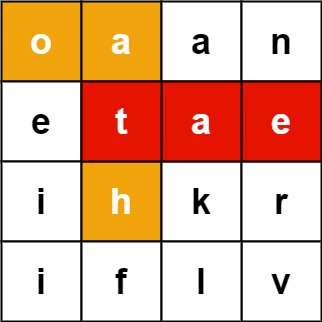
Example 1:
1
2
Input: board = [["o","a","a","n"],["e","t","a","e"],["i","h","k","r"],["i","f","l","v"]], words = ["oath","pea","eat","rain"]
Output: ["eat","oath"]
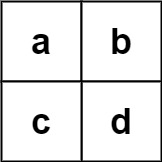
Example 2:
1
2
Input: board = [["a","b"],["c","d"]], words = ["abcb"]
Output: []
Constraints:
m == board.lengthn == board[i].length1 <= m, n <= 12board[i][j]is a lowercase English letter.1 <= words.length <= 3 * 1041 <= words[i].length <= 10words[i]consists of lowercase English letters.- All the strings of
wordsare unique.
Links
Question here and solution here
Solution
concept
This question needs Trie + standard DFS to solve.
code
1
2
3
4
5
6
7
8
9
10
11
12
13
14
15
16
17
18
19
20
21
22
23
24
25
26
27
28
29
30
31
32
33
34
35
36
37
38
39
40
41
42
43
44
45
class TrieNode:
    def __init__(self):
        self.children = {}
        self.end_of_word = False

    def add_word(self, word):
        cur = self
        for c in word:
            if c not in cur.children:
                cur.children[c] = TrieNode()
            cur = cur.children[c]
        cur.end_of_word = True

class Solution:
    def findWords(self, board: List[List[str]], words: List[str]) -> List[str]:
        root = TrieNode()
        for w in words:
            root.add_word(w)

        ROWS, COLS = len(board), len(board[0])
        result, visited = set(), set()
        directions = [[0,1], [1,0], [0, -1], [-1, 0]]

        def dfs(r, c, node, word):
            if (r < 0 or r >= ROWS or
                c < 0 or c >= COLS or
                (r,c) in visited or board[r][c] not in node.children):
                return

            visited.add((r, c))
            node = node.children[board[r][c]]
            word += board[r][c]
            if node.end_of_word:
                result.add(word)

            for dr, dc in directions:
                dfs(r + dr, c + dc, node, word)

            visited.remove((r,c))

        for r in range(ROWS):
            for c in range(COLS):
                dfs(r,c, root, "")

        return list(result)
Complexity
time: $O(m \times n \times 4 \times 3^{t-1} + s)$
space: $O(n)$
This post is licensed under CC BY 4.0 by the author.