LC 329 - Longest Increasing Path in a Matrix
LC 329 - Longest Increasing Path in a Matrix
Question
Given an m x n integers matrix, return the length of the longest increasing path in matrix.
From each cell, you can either move in four directions: left, right, up, or down. You may not move diagonally or move outside the boundary (i.e., wrap-around is not allowed).
Example 1:
1
2
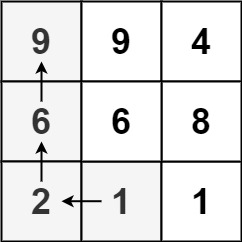
Input: matrix = [[9,9,4],[6,6,8],[2,1,1]]
Output: 4
Explanation: The longest increasing path is [1, 2, 6, 9].
Example 2:
1
2
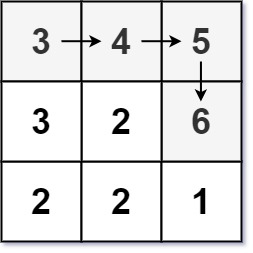
Input: matrix = [[3,4,5],[3,2,6],[2,2,1]]
Output: 4
Explanation: The longest increasing path is [3, 4, 5, 6]. Moving diagonally is not allowed.
Example 3:
1
2
Input: matrix = [[1]]
Output: 1
Constraints:
m == matrix.lengthn == matrix[i].length1 <= m, n <= 2000 <= matrix[i][j] <= 231 - 1
Links
Question here and solution here
Solution
concept
The top down solution is simple, just DFS with caching. There is no bottom up solution from NeetCode.
code
1
2
3
4
5
6
7
8
9
10
11
12
13
14
15
16
17
18
19
20
21
22
23
24
25
26
27
28
29
30
31
32
33
34
35
36
37
38
39
40
41
42
43
44
45
46
47
48
49
50
51
52
53
54
55
56
57
58
class Solution:
	"""
	brute force DFS
	TLE
	"""
    def longestIncreasingPath(self, matrix: List[List[int]]) -> int:
        ROWS, COLS = len(matrix), len(matrix[0])
        directions = [(0,1), (1,0), (0,-1), (-1,0)]
		# no need visited set since we are looking for increasing, visited cell will be smaller than currently searching cell so it gets rejected
        def dfs(r, c, prev_val):
            if (r < 0 or r >= ROWS
                or c < 0 or c >= COLS
                or matrix[r][c] <= prev_val):
                return 0

            ans = 1
            for dr, dc in directions:
                ans = max(ans, 1 + dfs(r + dr, c + dc, matrix[r][c]))

            return ans

        LIP = 0
        for r in range(ROWS):
            for c in range(COLS):
                LIP = max(LIP, dfs(r,c,-1))

        return LIP

class Solution:
	"""
	top down: memoization
	"""
    def longestIncreasingPath(self, matrix: List[List[int]]) -> int:
        ROWS, COLS = len(matrix), len(matrix[0])
        directions = [(0,1), (1,0), (0,-1), (-1,0)]
        cache = {} # (r,c) -> LIP

        def dfs(r, c, prev_val):
            if (r < 0 or r >= ROWS
                or c < 0 or c >= COLS
                or matrix[r][c] <= prev_val):
                return 0

            if (r,c) in cache:
                return cache[(r,c)]

            ans = 1
            for dr, dc in directions:
                ans = max(ans, 1 + dfs(r + dr, c + dc, matrix[r][c]))
            cache[(r,c)] = ans
            return cache[(r,c)]

        LIP = 0
        for r in range(ROWS):
            for c in range(COLS):
                LIP = max(LIP, dfs(r,c,-1))

        return LIP
Complexity
time: $O(mn)$
space: $O(mn)$
This post is licensed under CC BY 4.0 by the author.